

An HMO license is a permission issued by the relevant local authority for a property that falls within a licensing requirement. Whether you need one depends on the number of occupiers, the households they form, the facilities they share, the property type and the licensing rules in the part of the UK where the property is located. This guide explains the main national rules, council licensing schemes, fees and checks to make before you buy or let.
Quick answer — In England, mandatory HMO licensing generally applies where five or more people from two or more households occupy an HMO and share facilities, subject to the statutory property tests. Smaller HMOs may need a license under a local additional licensing scheme. Wales retains a three-storey test for mandatory licensing; Scotland and Northern Ireland have separate regimes. Always check the rules and any local scheme for the property address.
Key takeaways
- England’s mandatory threshold is five or more people from two or more households.
- Councils can add licensing for smaller HMOs (additional) or for most rented homes in an area (selective).
- Wales, Scotland and Northern Ireland have separate rules; do not assume England’s licensing threshold applies across the UK.
- The three checked here ranged from £975 to £1,872 for a new licence, and some councils charge less than £900.
- For relevant English offences committed on or after 1 May 2026, certain civil penalties can reach £40,000 and rent repayment orders can cover up to 24 months’ rent; earlier offences may be subject to lower limits.
What counts as an HMO?
In England and Wales, a property will generally be an HMO under the standard test where at least three people forming more than one household occupy it as their only or main residence, rent is payable, and they share basic amenities such as a kitchen, bathroom or toilet. The Housing Act 2004 also contains other tests for converted buildings and self-contained flats, so the standard test is not the only route by which a property can be an HMO. (GOV.UK, checked 17 November 2026).
A “household” is one person, or members of one family living together, including couples. Three friends sharing form three households. A couple plus one lodger form two.
A property can be an HMO without automatically requiring a mandatory HMO licence. In England, the usual mandatory occupation threshold is five or more people from two or more households, but other property tests and local additional licensing schemes can change the outcome. Do not assume that a property with three or four occupiers is exempt.

Do you need an HMO licence? Rules by licence type
In England, mandatory licensing applies from five occupants in two or more households. Additional and selective schemes only apply where your council has designated an area.
| Mandatory | Additional | Selective | |
| Applies to | HMOs with 5+ people, 2+ households, shared facilities | Smaller HMOs not covered by mandatory | Most privately rented homes in a designated area, HMO or not |
| Who decides | National law (Housing Act 2004), issued by your council | Your council, by area | Your council, by area |
| What to check | Occupants, households, shared facilities | Council’s additional scheme map | Whether your address sits in a designated area |
Local schemes differ. Birmingham introduced additional licensing from 5 June 2023, and Leeds launched selective licensing on 9 February 2026. Manchester says it has no additional scheme, but it does run selective licensing in specific areas.
How do HMO regulations differ across the UK?
Each nation sets its own threshold and regulator. Always check with the council covering the property.
| Nation | Key threshold | Regulator |
| England | 5+ people, 2+ households, any number of storeys (since 1 October 2018) | Local council |
| Wales | 5+ people, 2+ households and 3+ storeys; councils may add additional licensing | Local council, plus landlord registration and licensing with Rent Smart Wales |
| Scotland | 3+ people from more than two families, as their main home | Local council (mygov.scot); licence usually lasts 3 years |
| Northern Ireland | 3+ people from more than two households, sharing facilities and with at least one paying rent | District council (nidirect) |
GOV.UK’s general HMO page covers England and Wales together, so confirm the Welsh storey test with your council. Rent Smart Wales registration is separate from HMO licensing and applies per landlord.
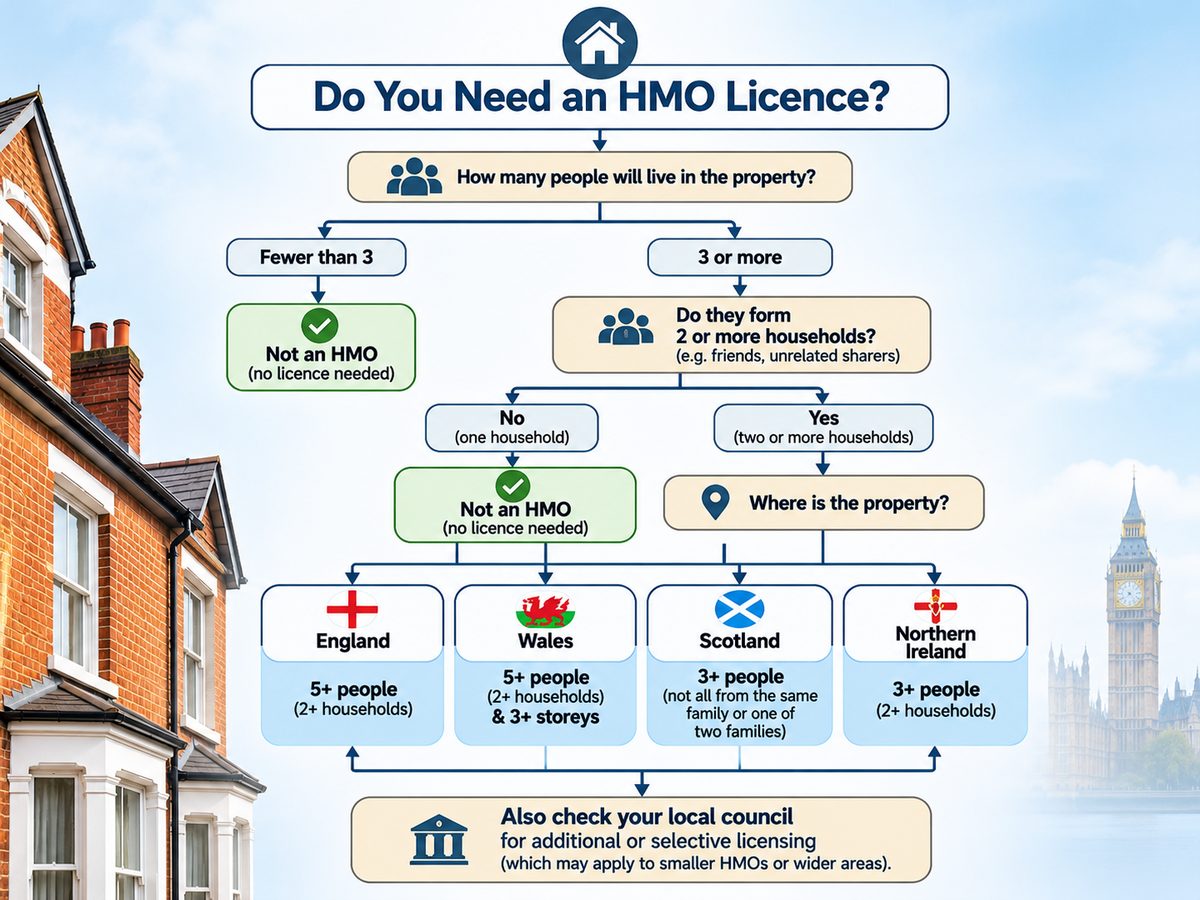
How to check if you need an HMO license
Count the occupants and households, then confirm your council’s schemes and the planning position in writing before you let or buy.
- Count occupants and households. Include everyone living there as their main home. Two or more households sharing facilities is the trigger.
- Check the council’s licensing page. Look for its mandatory, additional and selective schemes, and use any postcode checker.
- Check planning. Small HMOs (3-6 people) fall under use class C4, and 7 or more is sui generis. An Article 4 direction can require planning permission to change a home (C3) to a small HMO. See the Planning Portal’s use classes guide.
- Check mortgage and insurance conditions. Lenders and insurers often set their own HMO requirements. Read these buy-to-let mortgage truths before borrowing.
- Ask the council in writing. A written reply gives you a record. It is not a guaranteed defence, as courts have rejected “the council told me” arguments.
How much does an HMO license cost in the UK?
HMO licence costs are set by each council. The three English councils checked charge roughly £975 to £1,872 for a new licence, but this is not a UK-wide range: South Cambridgeshire, for example, charges £895 for a five-year licence for up to five bedrooms in 2026/27. scambs
Fees depend on the council’s fee structure, whether you are at application or grant stage, and the number of rooms or occupants. Most councils split the fee into two parts.
| Council | New license fee | Basis |
| Manchester | £1,321 | 5 occupants (£865 admin + £456 grant) |
| Leeds | £975 | £635 first stage + £340 second stage; £825 for Leeds Rental Standard members |
| Barnet | £1,872 | Up to 5 units, 5-year licence; fees from 1 January 2026 |
Last checked 17 November 2026. These are not UK-wide figures, so check your own council’s fee page.
Hidden costs to budget for:
- Fire safety works (alarms, fire doors, emergency lighting where required)
- Changes needed to meet minimum room sizes
- Gas safety certificate and an electrical installation condition report (EICR)
- Management time or an agent’s fees
For the wider financial picture, see these property income tax truths.
Can you legally avoid needing an HMO licence?
Only by genuinely changing how the property is occupied or by qualifying for a recognized exemption. “Workarounds” such as sham tenancy structures do not work.
Lawful routes:
- Fewer occupants. In England, four or fewer sharers fall below mandatory licensing. Check for an additional scheme, and note that management rules still apply.
- A genuine single household. A family or couple counts as one household.
- Exemptions. Properties owned or managed by councils, housing associations, police, NHS or fire services are exempt (Norwich City Council). An individual flat in a purpose-built block of three or more flats is also outside mandatory licensing (Nottingham City Council).
- Resident-landlord limits. Manchester notes that living with three or more lodgers may require a licence.
- Temporary exemption notice. Councils can grant one while you take steps to remove a property from licensing.
Why workarounds backfire. Licensing turns on how the property is actually occupied, not on what the paperwork says. Shelter’s legal guidance notes that relying on an agent, or on a council officer’s informal comment, has failed as a “reasonable excuse” defence.
Penalties for an unlicensed HMO (England):
| Sanction | Position |
| Prosecution | Unlimited fine (GOV.UK) |
| Civil penalty | Up to £40,000 per offence for offences from 1 May 2026; £30,000 before (Shelter) |
| Rent repayment order | Up to 24 months’ rent from 1 May 2026 (council guidance on the Renters’ Rights Act) |
| Banning order | Possible for licensing offences (Shelter) |
| Mortgage and insurance | Check your lender and insurer. Amounts vary |
Avoid the traps in these property investment mistakes.
How do you get an HMO licence?
Apply to your local council, pay the fee and pass the fit-and-proper-person and property suitability checks. In England, GOV.UK says a licence lasts a maximum of five years.
Typical documents (they vary by council):
- Floor plan showing rooms, sizes and amenities
- Gas safety certificate
- EICR, often dated within the last five years
- Fit-and-proper-person declaration, and sometimes a basic DBS certificate
- Sample tenancy agreement
Timeline. One council quotes about two months to process an application. For renewals, apply at least two months before expiry (Arun District Council), and some councils set a hard cut-off of 28 days.
Conditions. GOV.UK lists an annual gas safety certificate sent to the council, working smoke alarms and electrical appliance certificates on request. Councils can add conditions, and you can appeal to the First-tier Tribunal.
What HMO regulations and standards apply?
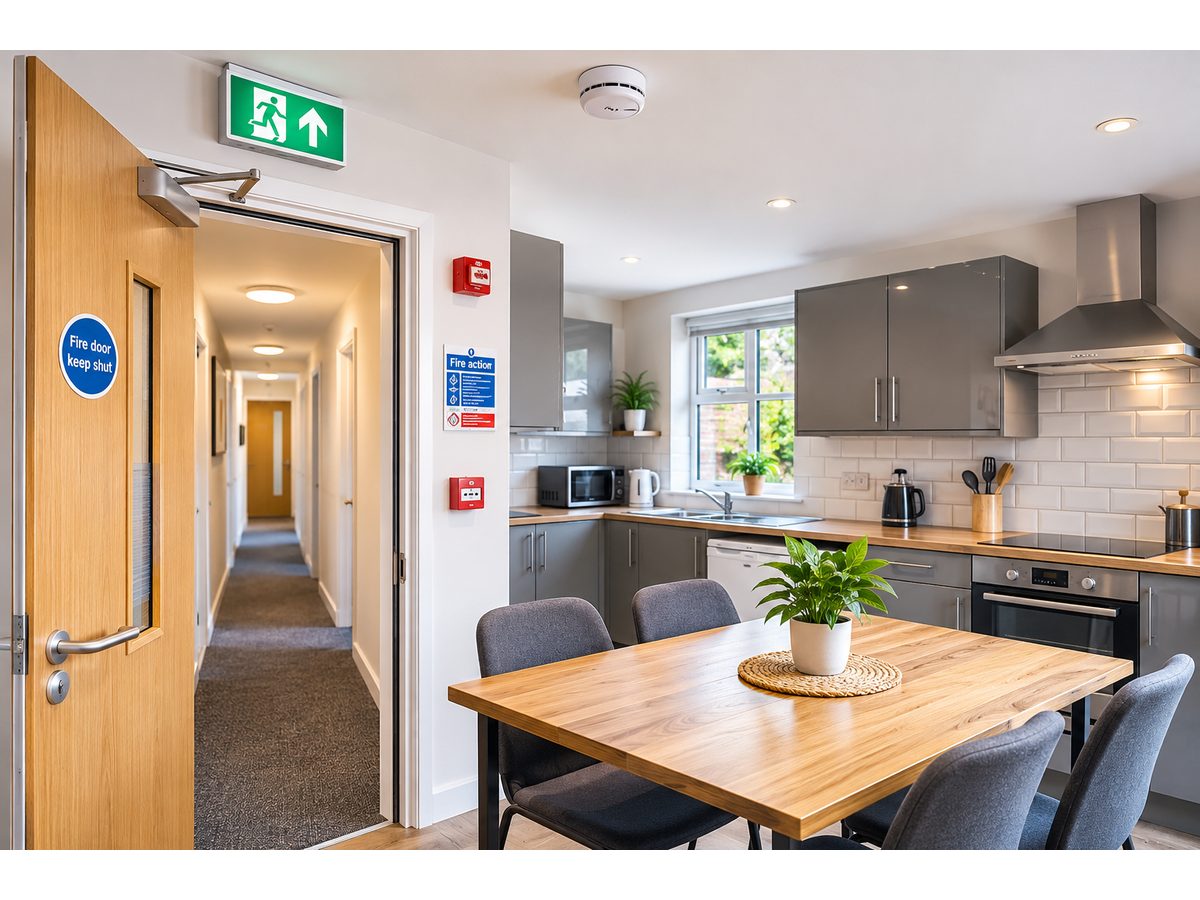
All HMOs in England must follow the Management of Houses in Multiple Occupation Regulations 2006. Licensed HMOs also carry mandatory conditions on room sizes, waste and safety.
Minimum sleeping room sizes (England, licensed HMOs):
- 6.51 m² for one adult
- 10.22 m² for two adults
- 4.64 m² for a child under 10
- Rooms under 4.64 m² cannot be used for sleeping
Councils can set higher local standards. The NRLA’s amenity standards guide is a useful reference.
Compliance checklist:
- Fire alarm system, fire doors and escape routes as your council requires
- Annual gas safety check and valid EICR
- Adequate bathrooms, toilets and kitchen facilities for the occupant numbers
- Waste and recycling arrangements
- Clear management contact details for tenants
Good systems make this easier. See these portfolio management principles.
Is an HMO still worth it?
It can be, but licensing, safety works and management cost money, and enforcement has tightened. No yield is guaranteed, so run the numbers on your own property.
The Renters’ Rights Act 2025 began its first phase on 1 May 2026. Section 21 no-fault evictions ended, most assured shorthold tenancies became assured tenancies, and penalties rose. A national landlord database is due from late 2026, with an ombudsman expected later. The sources checked still describe the five-person mandatory threshold as current.
Test your figures with the rental yield calculator and the buy-to-let calculator. For a real example, read this 3-bed to 7-bed HMO conversion case study. To learn the model step by step, see the rent-to-rent HMO course.
FAQ
How much does an HMO licence cost in the UK?
Fees are set by each council. The three English councils checked charge £975 to £1,872 for a new licence, but some charge less and some more, so check your council’s current fee page.
How do I get an HMO licence?
Apply to your local council with your plans, safety certificates and fit-and-proper declaration, then pay the fee. In England the licence lasts up to five years.
What are the HMO regulations in the UK?
Each nation has its own rules. In England, the Housing Act 2004, the 2006 management regulations and mandatory licence conditions apply, including minimum room sizes.
How do you get around an HMO licence?
Lawfully, only by reducing occupancy below the threshold, operating as a genuine single household or qualifying for an exemption. Sham arrangements risk fines, rent repayment and banning orders.
Do I need an HMO licence for three or four tenants?
Not under England’s mandatory rules, but your council may run an additional or selective scheme that requires one. In Scotland, three or more qualifying people can need a licence.
How long does an HMO licence last?
In England, a maximum of five years. In Scotland, usually three years.
Conclusion and next steps
Checking whether you need an HMO licence takes minutes, and getting it wrong can cost far more than the fee. Count occupants and households, check your council’s schemes and planning position, and ask in writing.
If you want to build an HMO strategy with the compliance side handled properly, explore the rent-to-rent HMO course, read about Rahim Bah, or contact the team.
Disclaimer: this is general information, not legal advice. Check with your local council or a qualified property solicitor before acting.

Rahim Bah is an entrepreneur, property investor, author and educator. He shares practical insights on entrepreneurship, wealth creation and personal growth, inspiring others to recognise opportunities and achieve success.